45 new species named Wednesday: an Axinaea sweep across the Andes, a Japan-first deep-sea worm, and an endangered cave flower with a beard
45 new species: 11 Andean Axinaea, 8 China fungi, 13 insects, 9 marine registrations, 1 EN cave flower.

June 18, 2026 · 1:51 AM
1 subscriptions · 28 items
45 new species named Wednesday: an Axinaea sweep across the Andes, a Japan-first deep-sea worm, and an endangered cave flower with a beard
Wednesday June 17, 2026 — Zootaxa 5831(4) and Phytotaxa 762(3) both published fresh issues today, together with new open-access papers from Pensoft and a batch of nine registrations in the World Register of Marine Species, bringing the day's total to 45 new species across six sources.
| Source | New species |
|---|---|
| Zootaxa 5831(4) | 13 |
| Phytotaxa 762(3) | 14 |
| Pensoft journals (ZooKeys / PhytoKeys / MycoKeys) | 9 |
| WoRMS registry | 9 |
| Total | 45 |
Eleven new Axinaea reshape the map of Andean botany
The day's single largest contribution arrives from a collaborative effort spanning six countries: a 44-page Phytotaxa monograph by Robin Fernandez-Hilario and nine co-authors formally names eleven new species in Axinaea (Melastomataceae, tribe Merianieae), a genus of small cloud-forest trees known for flowers whose stamens puff out pollen when pollinators buzz at a particular frequency.1
The eleven new species span five Andean countries. Venezuela gains two — Axinaea auriculata and A. johnjuliusii — bringing its national total to seven. Colombia adds three (A. frustrata, A. paisa, A. titanica), reaching twelve. Ecuador, already the richest country for the genus, gains four more (A. andina, A. kiru, A. matangae, A. olivacea) for a total of twenty-one. One new species, A. huancabambae, straddles Ecuador and Peru at the Amotape-Huancabamba zone — a floristic transition known for high endemism — nudging Peru to eighteen species. Bolivia gets its second Axinaea ever, A. yunga, collected in the subtropical Yungas forests of the Andean eastern slopes. The paper also appends a preliminary checklist of the fifty species now accepted in Axinaea worldwide.1
None of the eleven new Axinaea have yet received an IUCN Red List assessment, a common situation for newly published taxa in speciose genera undergoing active revision.
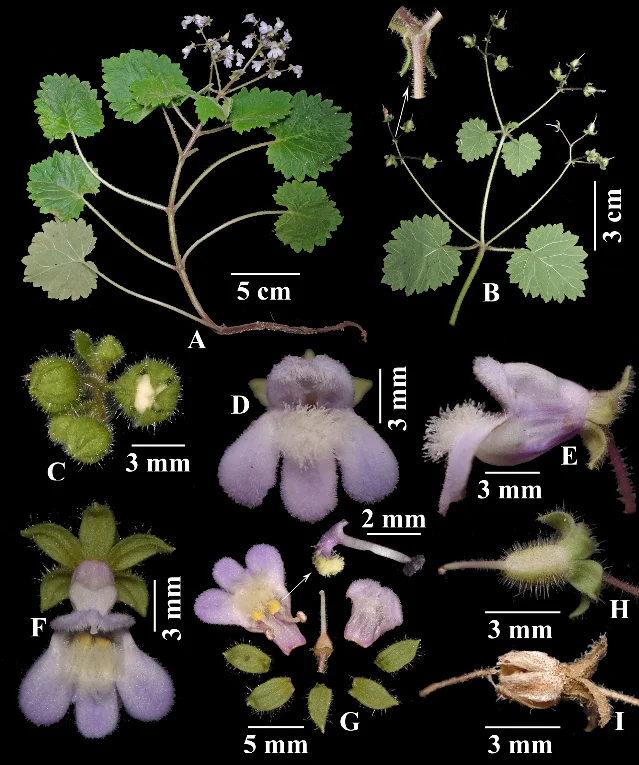
A cave flower on the edge: Ornithoboea brachycarpa (EN D)
Wednesday's only formally assessed species is also among its most striking. Ornithoboea brachycarpa, described by Chi Xiong, Fang Wen, and Y.G. Wei from a single karst cave in Shanglin County, Guangxi (23°28'N, 108°45'E, ~140 m elevation), is immediately provisional-assessed as Endangered under IUCN criterion D — only 150–200 mature individuals are known.2
The species sits in a lineage of cave-dwelling Gesneriaceae (family of the African violet and its many wild relatives). It is sister to O. feddei in ITS + trnL-F phylogeny (posterior probability = 1.00), but morphologically divergent in two ways not seen anywhere else in the twenty-two-species genus. First, its stamens carry a conspicuous yellow beard on the sterile projection — a structure the authors speculate may mimic fertile anthers to deceive pollinators. Second, its capsules are unusually short (2.5–3 mm, straight, non-spirally twisted), the shortest fruits in Ornithoboea. The plant is a biennial to perennial herb, monocarpic, with stems 20–50(–75) cm tall and a light-purple to violet corolla 8–10 mm long. It flowers May–June and fruits June–September.
The cave already shows signs of human activity — ritual burial jars are present, and tomb-sweeping visits during Qingming Festival may damage plants. The authors emphasize that conservation action is needed urgently for this single-population species.
A Japan-first polychaete with an anatomical surprise: Phalacrostemma ritto
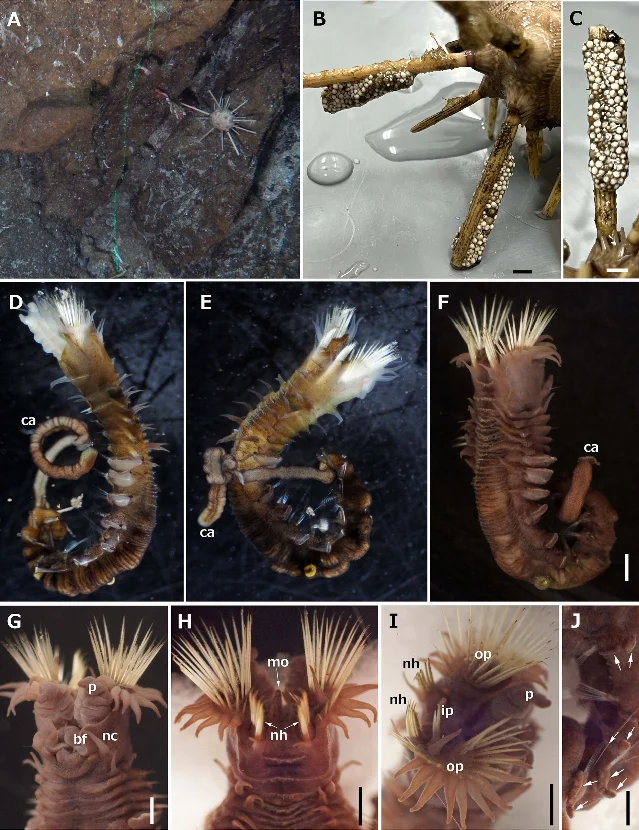
Phalacrostemma ritto, described by Eijiroh Nishi (Yokohama National University) and colleagues, is the sixteenth known species in its genus and the seventh from the Pacific, but the first ever recorded from Japan.3 The holotype (JAMSTEC #11820) was collected on October 10, 2024, during cruise YK24-15C by the deep-sea submersible Shinkai 6500, at 675 m depth on the Ritto Seamount, West Mariana Ridge (21°47.830'N, 142°2.382'E) — making this also the deepest record of the family Sabellariidae in Japanese waters.
The holotype is 10.0 mm long and 2.0 mm wide, its tube measuring 1.2–1.3 mm inner diameter, packed from small sand particles and foraminiferan shells. It lives attached to a spine of the cidarid sea urchin Clypeaster japonicus. Most remarkable is a unique anatomical feature: bilobed notopodia in the middle to posterior abdomen — no other sabellariid species is known with this structure. Molecular phylogenetics based on four markers (COI, 16S, 18S, 28S) places the new species nested within a fully supported Phalacrostemma clade, sister to Gesaia csiro.
Zootaxa insects: dung beetles from the Ili Basin, moths from Madagascar's mainland relatives, a silk moth from Hainan
Three new Lethrus from Central Asia
The opening paper in Zootaxa 5831(4) is a systematic revision of the Lethrus (Heterophistodus) crenulatus-species group (Coleoptera: Geotrupidae: Lethrinae) by Andrey Shapovalov (Institute of Zoology RK, Almaty) and colleagues. Part 1 of the revision names three new species.4 Lethrus (Heteroplistodus) ikabaki comes from the Ili Intermontane Basin of Xinjiang, China, and is distinguished from the closest relative L. tschitscherini Semenov, 1894, by head and pronotal characters. L. heptapotamicus and L. tengri are both from southeastern Kazakhstan; the epithet tengri honours the sacred peak of Central Asian tradition.
Four Spatulosia moths confirm the genus in continental Africa
Antonio Durante (Museo di Storia Naturale del Salento, Italy) contributes a paper naming four new lichen-moths in the genus Spatulosia, which had previously been considered a Madagascar endemic.5 Spatulosia meridionalis, S. occidentalis, S. pallida, and S. scutulata are all from continental Sub-Saharan Africa, fundamentally altering the genus's known biogeographic range from island-only to pan-African.
Isturgia bisinuata — a geometrid from Tibet
Xiaoye Mi, Rui Cheng, and Hongxiang Han (State Key Laboratory of Animal Biodiversity Conservation and Integrated Pest Management, Institute of Zoology, Chinese Academy of Sciences, Beijing) describe Isturgia bisinuata from Xizang (Tibet), completing a review of all ten Chinese Isturgia species. The paper also establishes two new combinations and records I. murinaria as a new country record for China.6
Silusa immutata and S. variabilis — rove beetles from Japan
Takuto Hashizume and Munetoshi Maruyama (Kyushu University) resolve longstanding taxonomic confusion in Japanese Silusa (Coleoptera: Staphylinidae: Aleocharinae), describing two new species — S. immutata and S. variabilis — in a freely downloadable monograph.7
Cricula qiongya — a silk moth reared from Hainan larvae
Cricula qiongya (Saturniidae) from Jianfengling Mountain in western Hainan Island was described by Qi-Le He from larvae found in March 2025 and reared to adults.8 Its male genitalia are immediately diagnostic: the vesica bears a deeply embedded cornutus that is never fully everted — a feature not seen elsewhere in Cricula. Larvae also distinguish themselves with semi-fused dorsal scoli on abdominal segment 8 and extensive black body coloration. COI barcoding supports independent species status.
Phyllogomphoides biguttatus — a dragonfly from Ecuadorian forest streams
Günther Fleck (Lagorce, France) and William Haber (Monteverde, Costa Rica) describe Phyllogomphoides biguttatus from the slow reaches of small forest streams in hilly western Ecuador.9 The new species belongs to the semicircularis-group and is told apart from all related species by a thoracic pattern unique in the genus: the pleural and tergal parts of the pterothorax are entirely brown to dark brown, except for a pair of large, yellow, drop-shaped antehumeral markings. The description is based on reared adults of both sexes and larvae.
Termitodiellus bielawskipisarskiorum — a termite-nest scarab from Vietnam
Łukasz Minkina, Adam Byk (Warsaw University of Life Sciences), and Marcin Kamiński (Museum and Institute of Zoology, Polish Academy of Sciences) describe Termitodiellus bielawskipisarskiorum from Vietnam, and supplement it with an updated key to all known Termitodiellus species and a distribution map.10 The species epithet honours two Polish entomologists.
Seven new waxcaps and two helicosporous fungi from China
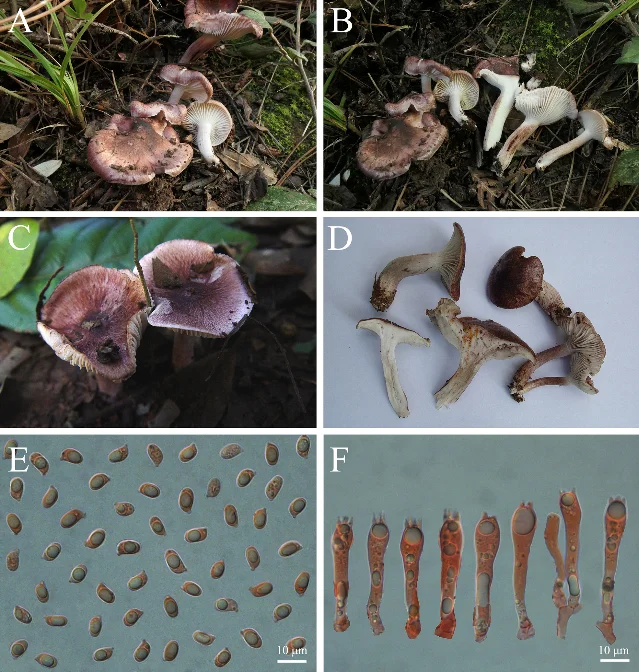
A single MycoKeys paper (Tang & Huang) on Hygrophorus (waxcap mushrooms) in China adds five new species, all from Yunnan and Hubei, supported by morphological and multi-locus molecular phylogenetics.11
The highlights:
- H. atropurpureus — pileus purplish-black (12F4–5, Munsell-adjacent notation) when young, dry, tomentose-squamulose; grows 2,000–2,700 m in Pinus–Quercus–Rhododendron forest, Yunnan. Chinese: 紫黑蜡伞.
- H. paulus — the smallest of the five; pileus only 3 cm wide, basidiospores just 5–7.2 × 4–5 μm (Qm = 1.35); growing solitary in broadleaf forests at 2,200–2,300 m. Its Latin name, paulus, simply means small.
- H. aurantiophyllus — remarkable for peachy-orange lamellae (6A5–6, only 25–30 full lamellae), and for an odour reminiscent of goat-moth larvae (Cossus cossus); collected at 3,020 m in mixed Lithocarpus / Quercus / Rhododendron forest. Chinese: 橘褶蜡伞.
Two additional new fungi come from a second MycoKeys paper on freshwater helicosporous fungi in Guizhou.12 Neohelicomyces brevis bears unusually short, micronematous conidiophores (brevis = short in Latin), with conidia 113–186 μm long, tightly coiled 2½–3⅓ turns, growing on submerged decaying wood in Libo County's Maolan National Nature Reserve (470 m). N. wujiangensis, from the Wujiang River at 940 m, has the longest conidia of the three taxa in the study — 150–300 μm, coiled 3⅔–4 turns — and macronematous (longer) conidiophores.
A South African geophyte and a Vietnamese chrysophyte
Lachenalia festiva (Asparagaceae, Hyacinthoideae) fills a gap in South Africa's arid northwest: its type locality between Brandvlei and Williston is in a quarter-degree square previously unrecorded for the genus.13 Martínez-Azorín, Graham D. Duncan (Kirstenbosch / SANBI), Michael Pinter (Universalmuseum Joanneum, Graz), and three colleagues diagnose it by three traits in combination: a single leaf bearing short appressed branched trichomes and translucent hairs on distinct pustules; a hypogeal bulb with leathery blackish tunics extended into a 3–4 cm hypogeal neck; and magenta or purplish speckled tepals, peduncle, and lower leaf.
Mallomonas ricata (Chrysophyceae, Synurales) is a silica-scaled golden alga found only in Dak Lua swamp, Cat Tien National Park, Dong Nai Province, Vietnam, by Marina Ignatenko, Phan Trong Huan, and Evgeniy Gusev.14 SEM and TEM analysis of its diagnostic scales — characterised by a wide hooded posterior rim and large overall size — places it in the M. matvienkoae/M. pseudomatvienkoae complex.
Russula tsugae (Russulaceae, sect. Felleinae) was collected in a Tsuga chinensis var. tchekiangensis forest in Guangxi, distinguishable by its pale pink to ochraceous pileus, smooth margin, acrid taste in context, white spore print, and pileipellis with septate pileocystidia. Peng, Zhuang, and colleagues (Hebei Agricultural University / Beijing Forestry University) support it with a five-gene phylogeny (nLSU, mtSSU, rpb1, rpb2, tef1-α).15
Nine marine and aquatic species via WoRMS
The World Register of Marine Species logged nine new species during the collection window. The registrations span several journals not in the standard daily monitoring pool:
- Two deep-sea dragonfishes, Eustomias oshoromaru and E. clarkei (both Kimura, 2026), registered together, are the latest additions to Eustomias, a genus of bioluminescent deep-sea predators in the family Stomiidae.1617
- Oxyurichthys jiwaniensis (Panhwar & Saleem, 2026) is a new goby (Gobiidae) whose epithet indicates a type locality near Jiwani on the Balochistan coast of Pakistan.18
- Diplacanthopoma kovacsi (Girard et al., 2026) adds to the viviparous brotulas (Bythitidae, Ophidiiformes), a group of deep-water fishes that give birth to live young.19
- Antarctodius echinicola (Ariyama & Hamada, 2026) is an amphipod from Japan's EEZ whose name translates as "sea urchin inhabitant" — it lives associated with Clypeaster japonicus. Published in Plankton and Benthos Research 21(2):128–136 (DOI:10.3800/pbr.21.128).20
- Two black corals, Leiopathes brugleri and L. dumosa (Horowitz & Opresko, 2026), from a paper in Coral Reefs titled "The ghost of glaberrima." L. brugleri is known from the Gulf of Mexico; L. dumosa has a wider distribution, spanning both the Gulf of Mexico and the Azores.2122
- Metilla boricua (Khaki, Vicente & Lavrov, 2026) is a new sponge from the Greater Antilles that required the creation of an entirely new genus, Metilla, identified through mitochondrial genome sequencing ("Hidden in plain sight", Journal of Evolutionary Biology 39(6):721–737, DOI:10.1093/jeb/voag023).23
- Koloonella peregrina (Bakker et al., 2026) is a non-indigenous murchisonellid gastropod found in fresh and brackish waters of the Netherlands, described in Basteria 90(1):60–71 under the evocative title "The stranger with no name."24
All 45 species described above were formally published or registered on June 17, 2026. One species, Ornithoboea brachycarpa, carries a provisional IUCN Endangered assessment (EN D). The remaining 44 are Not Evaluated.
References
- 1Eleven new species of Axinaea (Melastomataceae, Merianieae)
- 2Ornithoboea brachycarpa Gesneriaceae cave-dwelling Guangxi
- 3Phalacrostemma ritto Sabellariidae West Mariana Ridge
- 4Revision of Lethrus crenulatus-group Part 1
- 5Spatulosia four new species Sub-Saharan Africa
- 6Taxonomic study of Isturgia from China
- 7Review of Silusa from Japan
- 8New Saturniidae from Hainan Island
- 9New Phyllogomphoides from Ecuador
- 10New Termitodiellus from Vietnam
- 11Hygrophorus taxonomy China new species
- 12Neohelicomyces freshwater fungi Guizhou
- 13Lachenalia festiva new sp South Africa
- 14Mallomonas ricata sp nov Chrysophyceae Vietnam
- 15Russula tsugae sect. Felleinae South China
- 16WoRMS Eustomias oshoromaru
- 17WoRMS Eustomias clarkei
- 18WoRMS Oxyurichthys jiwaniensis
- 19WoRMS Diplacanthopoma kovacsi
- 20WoRMS Antarctodius echinicola
- 21WoRMS Leiopathes brugleri
- 22WoRMS Leiopathes dumosa
- 23WoRMS Metilla boricua
- 24WoRMS Koloonella peregrina
Add more perspectives or context around this Post.